


Lessons
The First Salute: An Untold Story of the American Revolution
State standards
Sorry, it seems there are no state standards for the given selections.
Length: 60-120 minutes | Grades: 6-12 | Themes: Jewish peoplehood; the American Revolution; Economics; Hidden History
Lesson Overview
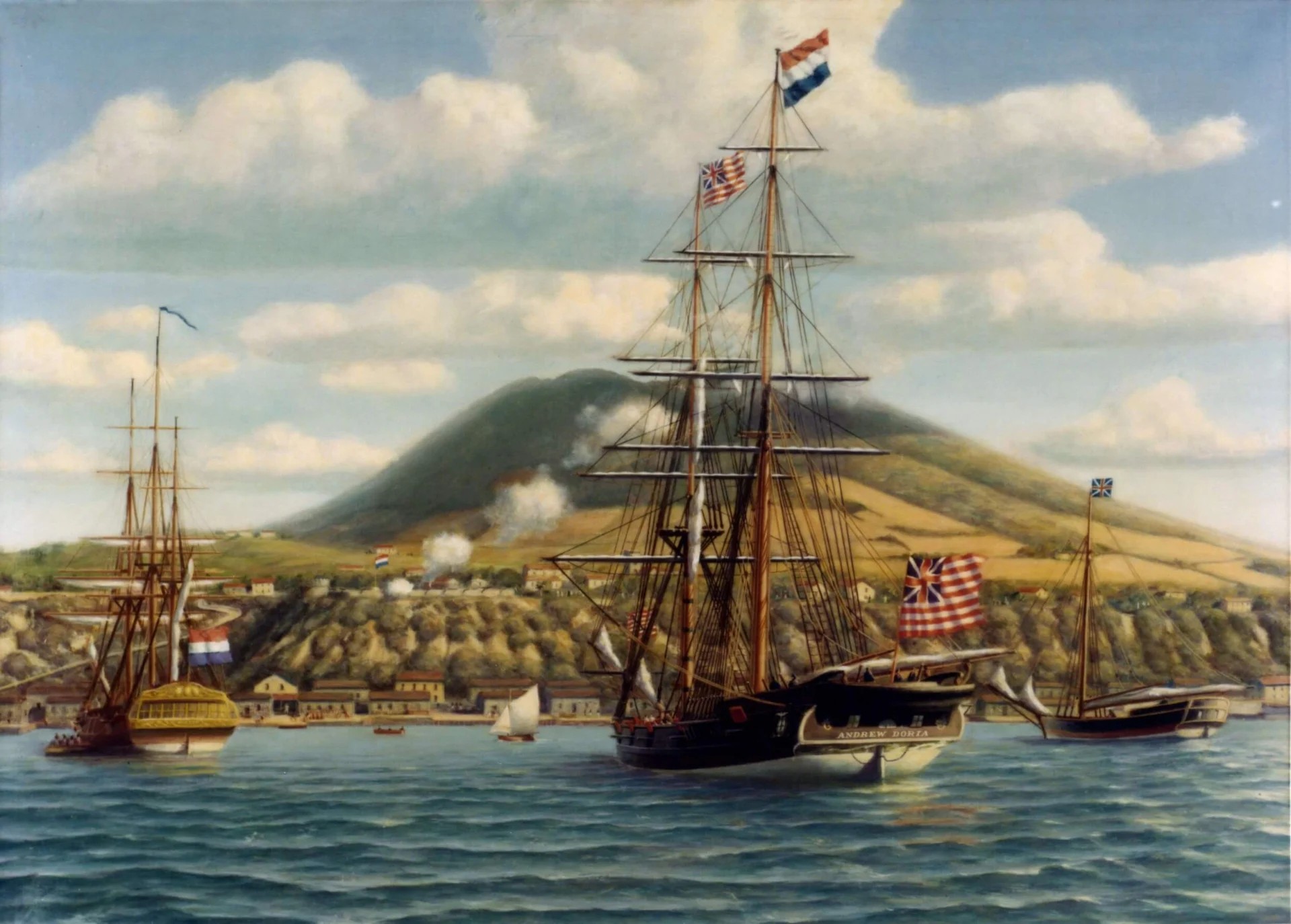
On October 13, 1776 the American warship Andrew Doria departed Gloucester, New Jersey and sailed down the Delaware River, headed for the tiny Dutch-controlled Caribbean Island of St. Eustatius. The Andrew Doria entered St. Eustatius’ harbor and issued a 13-cannon salute in honor of the 13 new states. St. Eustatius’s governor responded favorably by thundering his cannons. This exchange marks the first recognition of the United States of America by a foreign government – a moment now known as The First Salute.
Known as the “Golden Rock,” St. Eustatius served the Americas as a key trading hub, due to its advantageous location for trade between Europe, Africa, the Caribbean, South America, and North America. The tiny island regularly saw over 3,000 vessels docked annually at its port during the late eighteenth century, making it an international center for trade in sugar, coffee, tobacco, rum, hides, cacao, textiles, indigo, and human beings.
At the time of The First Salute, Jews comprised more than 30% of St. Eustatius’ 1,500 – 2,000 Europeans, drawn there by a culture of religious tolerance and economic freedom Jewish merchants, with their multilingual skills and family or business connections spanning Amsterdam to Curaçao to Philadelphia, proved particularly adept at coordinating complex trade across national or colonial boundaries. When war broke out in 1776, they were already favorably suited to support and supply the revolutionaries. with the munitions necessary to stand toe-to-toe with the well-equipped, professionally trained, superiorly armed British military.
These stories reveal how the American Revolution reverberated throughout Europe and the Caribbean and explore why and how Jews risked their lives and livelihoods for the promise of a new society where they could live freely. Moreover, it shows how religious liberty, communal networks, and individual courage positioned Jews to play crucial roles in securing independence and shaping the nation.
This lesson engages students in key questions faced by people who participated in the Revolution by focusing on St. Eustatius’ Jewish community. Through the interpretation of primary sources, they will engage in critical thinking, writing, and discussion.
Enduring Understanding
The First Salute and the story of the Jewish community on St. Eustatius help gain new insights into how the American Revolution was fought both on the field and commercially.
Life in the diaspora with a history of multiple cultural adaptations and expulsions uniquely prepared the Jewish community to be active participants in the American Revolution.
Hidden histories can unlock new ways of understanding.
Essential Questions
What is the story of the First Salute and why is it significant in understanding the ideal of religious freedom and the role of Jewish people in the American Revolution?
What may motivate people to take risks, even when the results are uncertain?
How does our understanding of the American Revolution change when we tell important yet underrepresented stories?
Learning Objectives
Students will be able to formulate authentic written/verbal responses to critical thinking designed questions.
Students will be able to compare, contrast, and differentiate seemingly disparate narrative threads to make a cohesive story – St. Eustatius, the Jewish People, and the American Revolution.
Students will be able to interpret primary source documents related to religious liberty, civic engagement, and routine happenings in the United States, Britain, Holland, and St. Eustatius.
Toolkit
-
The First Salute lesson plan
-
The First Salute slide deck
- The First Salute “Folly of Rodney” video
-
The First Salute primary sources
-
The First Salute lesson themes/discussion questions worksheet
-
The First Salute DBQ supplemental assignment
-
The First Salute supplemental reading